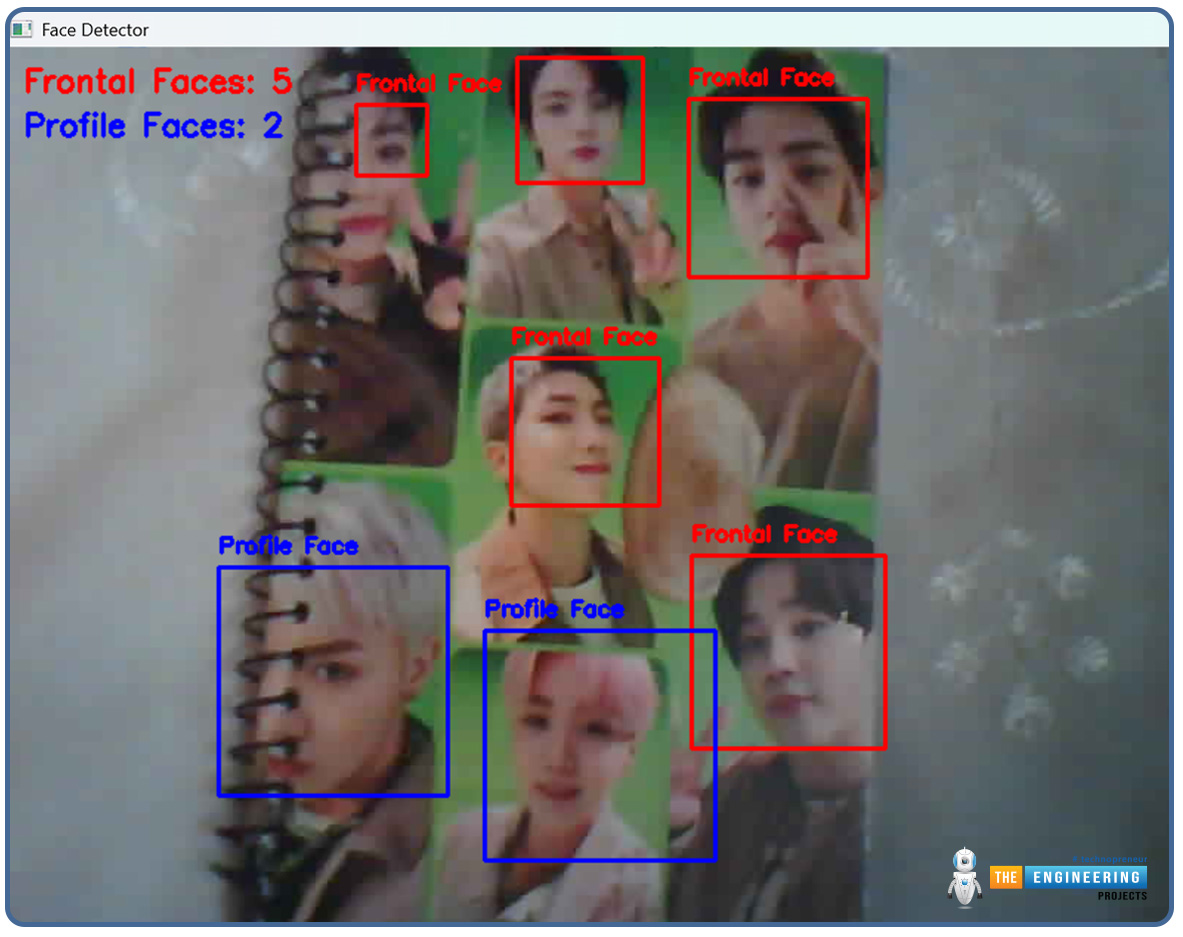
Hello friends. We hope you are doing fine. Today we are back with another interesting project. It is based on the image processing technology. Developing efficient and cost-effective solutions for real-time applications is becoming increasingly important in the area of embedded systems and computer vision. This project makes full use of ESP32-CAM. ESP32-CAM is a compact and AI-enabled microcontroller with built-in Wi-Fi capabilities. We will create a real-time face detection and counting system. The ESP32-CAM serves as the core of the system. It captures high-resolution images at 800x600 resolution and hosts an HTTP server to serve individual JPEG images over a local network. The device’s efficient JPEG compression and network capabilities ensure minimal latency while maintaining high-quality image delivery, enabling real-time processing on the client side. On the client side, a Python application powered by OpenCV collects image frames from the ESP32-CAM. Using Haar cascade classifiers, the application detects faces in each frame. It can also figure out whether they are frontal or in profile orientation. This project is focused on face detection and counting. It marks detected faces with bounding boxes. It also counts both frontal and profile faces seen in the video stream. Applications of this face detection and counting system include smart attendance systems, people flow monitoring in public spaces, and automation solutions in retail or event management. This project ...
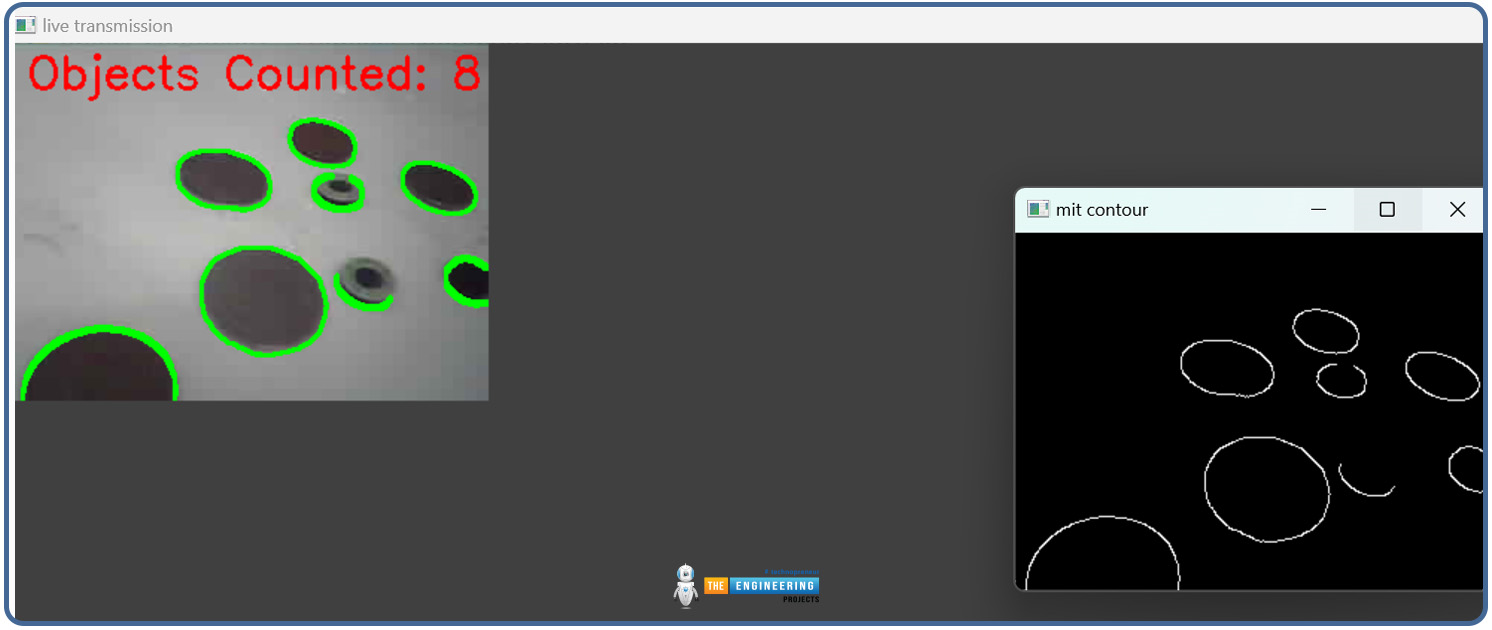
Imagine a real-time object counting system that is budget-friendly and easy to implement. You can achieve this goal with an ESP32-CAM. Today we will build an ESP32-CAM Object Counting System. This project is a combination of the power of embedded systems and computer vision. The main processor of the system is ESP32-CAM, a budget-friendly microcontroller with an integrated camera. This tiny powerhouse captures live video streams and transmits them over Wi-Fi. On the other side, a Python-based application processes these streams, detects objects using image processing techniques, and displays the count dynamically. Whether it’s tracking inventory in a warehouse, monitoring traffic flow, or automating production lines, this system is versatile and adaptable. You can implement this project with a minimum number of components. It is quite easy. Join us as we explore how to build this smart counting system step-by-step. You'll learn to configure the ESP32-CAM, process images in Python, and create a seamless, real-time object detection system. Let’s see how to bring this project to life! The ESP32-CAM Object Counting System is built on a modular and efficient architecture, combining hardware and software components to achieve real-time object detection and counting. Below is a detailed breakdown of the system architecture: This architecture ensures a clear separation of tasks, with the ESP32-CAM handling image capture and streaming, and the Python application focusing on image ...
It's not news that the world is one of portability now. Ever since laptops became more easily transportable and smartphones became the one object you could find in every person's pocket, desktop and fixed-location tech has been something of a relic of a bygone era. You're more likely to see a pig fly than someone under the age of 30 using a landline phone or desktop computer. However, as businesses have pivoted to online-first digital storefronts and presences, there has been a small section that has yet to catch up with the mobile-only generation with fully-optimized digital presences. Because of that, there's a clear niche that software engineers and developers can exploit and it could be 2025's hottest skill set for this group. Every industry is now aware of the fact that they can't rely on the old-school method of promotion and attracting customers. First, it was the need to have a simple website. Then it became the need for a mobile-optimised website. And now, it's imperative that businesses of many different kinds have a dedicated mobile app that can be used on a number of devices. The casino industry is a great microcosm of this. It's gone from being a solely brick-and-mortar deal to one that is almost primarily seen as digital. For example, Puntit is a solely-online betting platform with a fully optimized mobile website that replicates the aesthetic and functionality of a dedicated app that you would install from the Apple App Store or Google Play Store. With it clear ...
In today’s tutorial, we’ll show you how to program the ESP32-CAM module. ESP32-CAM module is suitable for building basic surveillance or monitoring systems. Its price is quite reasonable. You can use it for lots of AI-based projects like object detection, face recognition etc. Libraries ESP32 Simulation Libraries ESP32 boards and modules: ESP32 DevKit V1 · ESP32-DevKitC V4 · ESP32-S3 DevKitC-1 · ESP32-C3 SuperMini · ESP32-C6 DevKitC-1 · TTGO T-Display · T-Display S3 · XIAO ESP32-C3 · XIAO ESP32-S3 · ESP32 Feather V2 · QT Py ESP32-S3 · ESP32-C5 DevKitC-1 · Olimex ESP32-POE · FireBeetle 2 ESP32-E · T-Call SIM800L · T-SIM7600 · T-Beam Supreme · M5StickC PLUS2 · ESP32-2432S028 CYD · M5Stack AtomS3 · M5Stack Core2 · LilyGO T-Deck · LOLIN S2 Mini · Heltec WiFi LoRa 32 V3 · LilyGO T-Beam · ESP32-CAM · ESP32-WROOM-32 · AirLift WiFi Shield · AirLift ESP32 Breakout · WT32-ETH01 ESP8266 modules: ESP-01 · ESP-01S · ESP-07 · ESP-07S · ESP-12E · ESP-12F · ESP-01 Adapter · WiFi Shield · NodeMCU · NodeMCU V2 · D1 Mini · D1 R2 Helping Tools However, many users face hard luck when setting up and uploading code to ESP32-CAM development boards. This tutorial will provide you with a guideline for successfully programming the ESP32-CAM. The ESP32-CAM is a standalone development board that integrates an ESP32-S chip, a camera module, onboard flash memory, and a microSD card slot. It features built-in Wi-Fi and Bluetooth connectivity and supports OV2640 or OV7670 cameras with a resolution of up to 2 ...
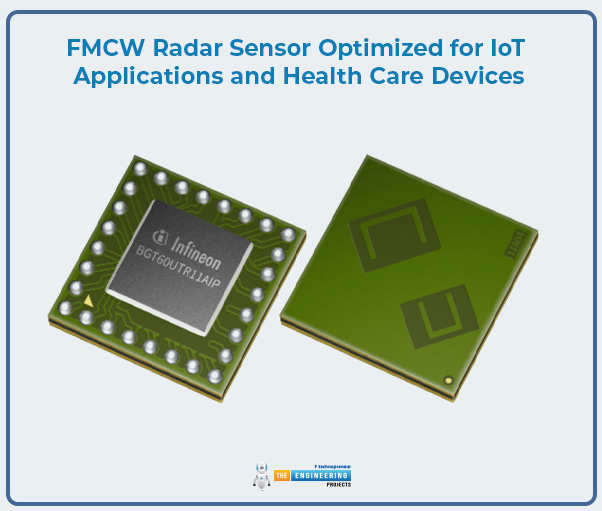
Hi readers! Hopefully, you are well and exploring technology daily. Today, the topic of our discourse is the FMCW Radar Sensor Optimized for IoT Applications and Health Care Devices. You might already know about it or something new and different. FMCW radar sensors are becoming one of the leading technologies in non-contact sensing and are very widely used nowadays in IoT and healthcare devices. In general, they have more accuracy, lower power consumption, and good performance on different surfaces. Hence, they can be highly versatile by emitting a continuous wave signal with frequency modulation, capable of detecting motions, measuring distance, and monitoring the presence of people with exceptional accuracy. This non-contact capability is an important feature for applications where hygiene and safety are a concern, like in healthcare settings that limit direct physical contact. In healthcare, FMCW radar sensors are applied for patient monitoring, fall detection, and tracking of breathing and heart rate without using invasive sensors. These abilities improve patient safety and comfort. In IoT, FMCW radar sensors are integrated into smart homes, energy-efficient lighting systems, and security solutions, where they can detect movement and optimize resource usage without human intervention. This article will discover its introduction, features and significations, working and principle, pinouts, datasheet, and applications. Let's start. FMCW radar sensors provide high precision ...
Hi readers! Hopefully, you are well and exploring technology daily. Today, the topic of our discourse is the LSM6DSL iNEMO Inertial Module, Always-on 3D Accelerometer, and 3D Gyroscope. You might already know about it or something new and different. The LSM6DSL is an iNEMO inertial module of the higher level offered by STMicroelectronics which combines a 3D accelerometer and a 3D gyroscope into one small unit. This sensor module will help to cater to clients' needs for more accuracy and energy-efficient motion sensing in the current world applications. Due to its battery-powered and continuous operation nature, it can principally used in battery gadgets such as smartphones, fitness trackers, and smartwatches. The LSM6DSL shines especially where high-resolution motion detection is possible that is accompanied by such features as activity recognition, steps taken count, and orientation tracking. An integrated Finite State Machine (FSM) and Machine Learning Core (MLC) enable on-device processing and are lighter on system resources than, for instance, neural networks. This makes it especially useful for applications requiring real-time processing, for instance, the Internet of Things, game controllers, and virtual reality products. Thanks to compatible standard communication interfaces such as I2C and SPI, the LSM6DSL participates perfectly in any control and regulation possibilities with microcontrollers and processors. Its embedded FIFO buffers enhance data accumulation and its ...
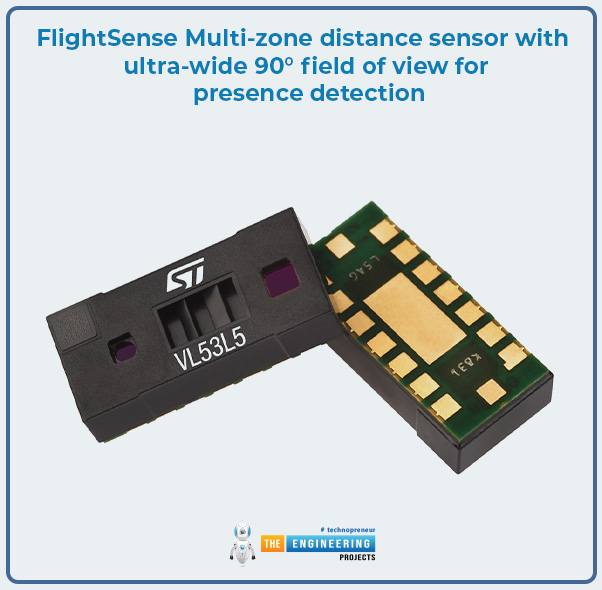
Hi readers! I hope you are fine and spending each day learning more about technology. Today, the subject of discussion is the FlightSense Multi-zone distance sensor with an ultra-wide 90° field of view for presence detection. It may be something you were aware of or something new and unique. The multi-zone distance sensors are developed by STMicroelectronics. They are high-tech ToF devices that ensure precise, reliable distance measurements. Distance is measured through infrared illumination, measuring the time light takes to return after its reflection off objects. These devices ensure that distance will be accurately calculated regardless of ambient light conditions. With an ultra-wide 90° field of view (FoV), it is possible to monitor several zones simultaneously, which enables the presence detection, motion tracking, and object localization that can be used for detection of multiple objects in a dynamic environment, even across large spaces. The sensors are compact and power-efficient, making them suitable for integration into a wide range of devices, including battery-operated systems. Standard communication interfaces like I²C and SPI ensure easy integration with microcontrollers and IoT platforms. Diverse applications of FlightSense sensors include smart homes where it enables automated lighting and energy management, robotics where it is used for navigation and obstacle detection, automotive systems where it improves occupant monitoring, and consumer electronics where ...
Hi readers! Hopefully, you are well and exploring technology daily. Today, the topic of our discourse is the MLX91218 and MLX91219 3.3V/5V sensors with high-accuracy simplify inverter/converter control and battery management. You might already know about it or something new and different. The Melexis MLX91218 and MLX91219 are magnetic field sensors that are of very high accuracy and are used in applications such as inverter/converter control and BMS. They possess an excellent quality level of accuracy in magnetic field sensing while consuming low power. They are, therefore, one of the best choices for modern electronic applications such as electric vehicles, industrial automation, renewable energy systems, and consumer electronics. The 3.3V or 5V wide range of voltage supply offers broad compatibility ranges of systems. Because of their application in reliable current measurement, position sensing, and motor control, the devices have usage in applications that range from inverter circuits, and battery management systems, to electric vehicles. It also makes sure to have low power operation for efficiency in power-constrained environments, and its capability to measure highly precise magnetic fields is of high importance for the control and optimization of power systems. The MLX91218 and MLX91219 sensors are indispensable in ensuring that any industry applying these devices will have their precise magnetic field sensing covered. This article will discover its introduction, ...
Hi readers! Hopefully, you are well and exploring technology daily. Today, the topic of our discourse is the HDC3020 and HDC3020 - Q1 humidity sensors with high accuracy, low power, and drift correction. You might already know about it or something new and different. The HDC3020 series is from Texas Instruments. It's a digital humidity and temperature sensor, known for high accuracy, reliability, and long-term stability. These sensors incorporate advanced drift correction mechanisms that maintain constant performance over long periods even in harsh or contaminant-rich environments, making it ideal for precision and dependable applications. The series has two main variants: the general-purpose application HDC3020 and the automotive-grade HDC3020-Q1, which complies strictly with the AEC Q100 qualification standards. Its variants boast exceptional humidity accuracies of ±1.5% and temperature accuracy of ±0.1°C over a wide temperature operating range of -40°C to 125°C and relative humidity of 0% to 100%. These sensors are optimized for minimal power consumption to enable their use in applications with battery operation, such as IoT systems and smart home appliances, in portable electronics. The HDC3020-Q1 device, which is automotive optimized, can be used for HVAC control, cabin monitoring, and defrost applications that will provide passenger comfort and safety. With their compact size, I²C interface, and robust design, the HDC3020 series makes integration easier and provides a ...
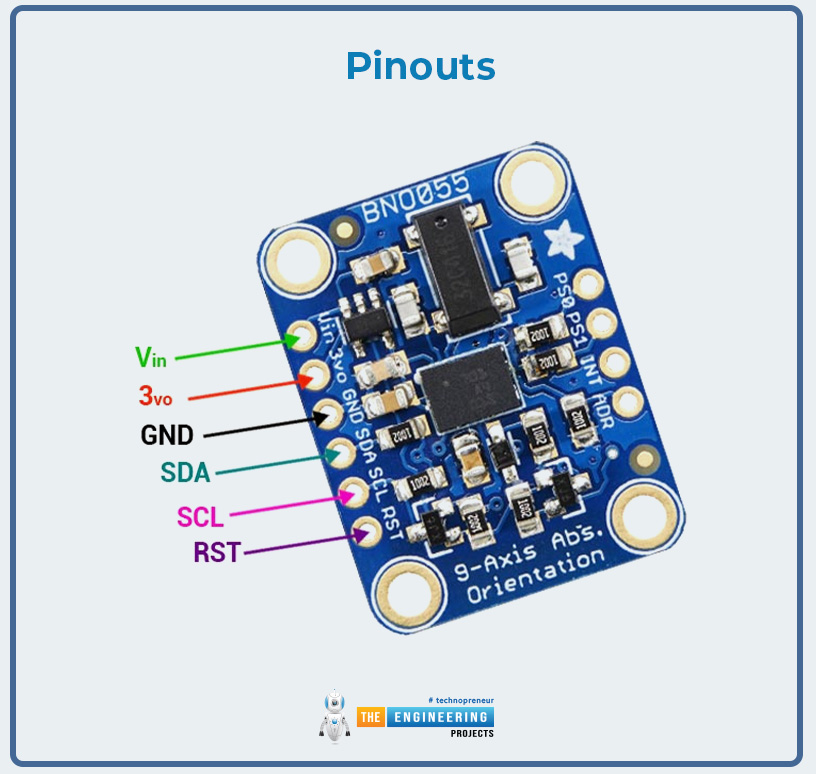
Hi readers! I hope you are fine and spending each day learning more about technology. Today, the subject of discussion is the BNO055- Intelligent 9-Axis Absolute Orientation Sensor Module. The BNO055 from Bosch Sensortec is a high-class motion sensor module combining a 3-axis accelerometer, 3-axis gyroscope, and 3-axis magnetometer using an onboard ARM Cortex-M0+ microcontroller. This makes it usable for delivering ready-to-use orientation data in formats that include Euler angles, quaternions, and linear acceleration. This module is designed with an embedded sensor fusion algorithm that offers accurate and drift-free orientation without extensive calibration or programming. It is compactly designed, low in power consumption, and easy to integrate into applications in robotics, wearable devices, drones, AR/VR systems, and IoT devices. BNO055 eliminates the complexity involved with traditional motion-sensing solutions due to its plug-and-play functionality. It has become a game-changing tool for developers and engineers in fields that demand accurate motion sensing and orientation tracking due to precise, real-time orientation data. This article will discover its introduction, features and significations, working principles, pinouts, datasheet, and applications. BNO055 has three essential sensors. Measures the linear acceleration in the X, Y, and Z axes. It helps detect movement, tilt, and forces of gravity. It measures the angular velocity of the X, Y, and Z axes. It detects ...