What is the Power Diode


What is the Power Diode
- Power Diodes are such semiconductor devices used in rectifier circuitries to rectify higher value current.
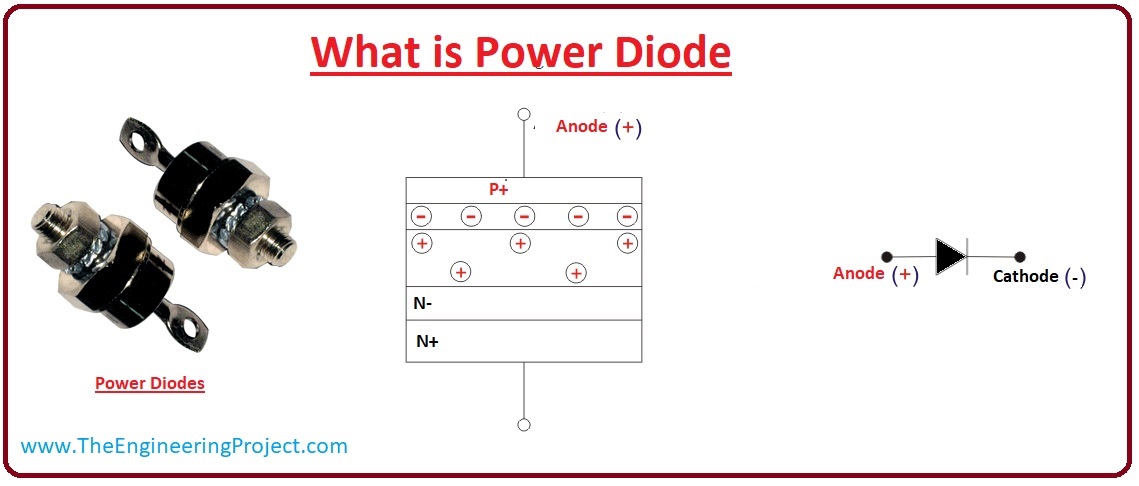
- This diode has a larger area of PN junction then other diodes, due to this ability is used to rectifier higher value current and voltage, like hundred amperes and thousand kilovolts.
- In normal diodes, both P and N portion have the equivalent doping level, but in power diodes, one side is highly doped and other is lightly doped.
- In the given diagram, you can see that there are three regions first one is highly doped (P+) and 2nd is less doped (N-) regions, both of these are joined with the highly doped (N+).
- The region (N-) is the main factor that makes power diodes useful for higher power circuitries.
- As (N-) is very less doped, due to this power diode also named as the PIN diode. In (PIN) the I for intrinsic.
Half Wave Rectification of Power Diode
- Such circuitry that converts the alternating current into the direct current is called rectifier circuit.
- The rectifier that converts half-wave of the alternating current into the direct current called half-wave rectifier.
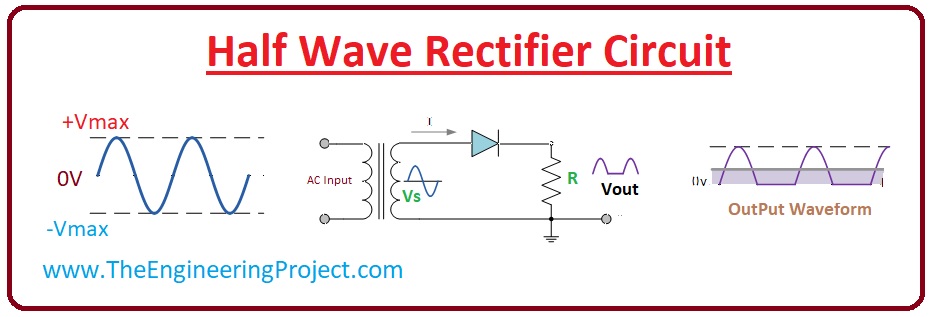
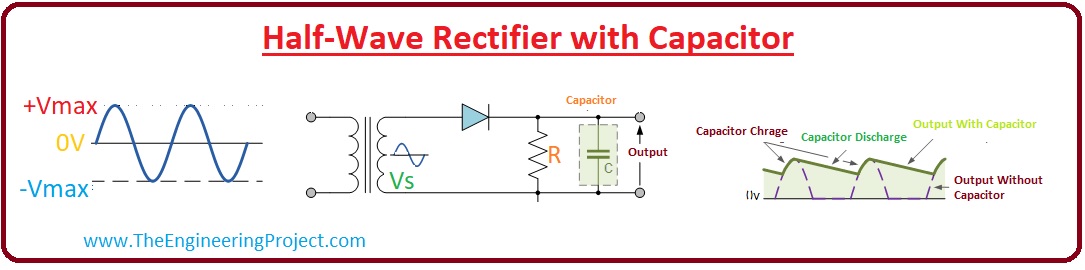
- In the given diagram you can see the circuitry of the half-wave rectifier, that has power diode and resistor (R) as output.
- You can see from the figure that the anode of the diode is connected with the positive end of the alternating current source through the transformer that used to step down the voltage and cathode is connected with the negative end. It is the forward-biased form of the diode.
- When the first half waveform of the alternating current passes through the diode, it rectifier this half-cycle to the DC and not work for the negative half of the wave.
- As the output is the resistance, so the current flowing through this resistance will follow Ohm's law, so the current of the resistance will directly proportionate to the applied voltage.
- The voltage across the resistance will be similar to the input supply Vs, for half sinewave voltage across the resistance will be Vs.
- When negative half of the wave reaches the diode it becomes reverse biased, the anode is at negative polarity and cathode at positive polarity. So no current will pass through the diode for negative half and the voltage across the load resistance will be zero.
- The given diagram explains the half-wave rectification.

- After rectification of the alternating current we got the direct current, this DC is not pure dc. There are some ripples present in the output of the rectifier circuitry.
- To reduce these ripples we use a capacitor at the output of the diode to get pure DC.
- There are some defects to use a capacitor for the elimination of the ripples. Because the higher output current will discharge the capacitor very fastly and capacitor stops working, due to this ripple do not remove from the output.
- So the use of capacitor for single-phase rectification is not good for ripples removal, instead, rectify the ac current by the full-wave rectifier.
- Due to this fact, a half-wave rectifier is used for less power consumption applications.

I-V characteristic Curve of Power Diode
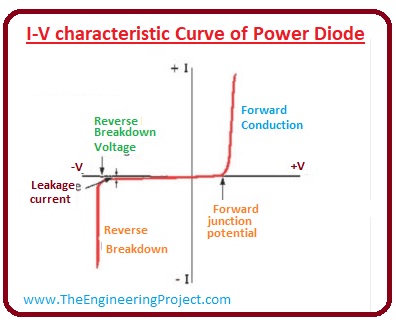
- You can see the voltage and current characteristics curve in the given figure.
- We can observe from the graph that the forward-biased current rises with the applied voltage.
- In reverse biased mode, very less leakage current flows, this current does not depend on the revered biased voltage.
- Minority charge carriers are the cause of the leakage current in reverse biased.
- When the value of reversed biased voltage approaches the break-down voltage avalanche break-down (is a fact that can happen in insulators and semiconductors. It is a kind of electrical current multiplication that can concede large amount currents within substances) happens.

Difference between Diode and Power Diode
- Power diode and normal diodes have some dissimilarities that are described here with the detailed.
- The physical structure of the normal PN junction diode has an equal area of P and N sides but in power diode, one region is largely doped and other is less doped.
- The size of the normal diode is small and power diodes are available in a larger size
- Power diodes are mostly constructed by metallic components.
- Normal semiconductor diodes are used in lesser power circuitries that way there operates at less voltage.
- Power diodes are used in such devices that work on the kilovolts so they have higher ratings.
- The current ratings of the power diodes are higher than the normal diodes. Power diodes work for such circuitries where hundred amperes current is required.
- As the current and voltage ratings of the power diodes are higher so they have the ability to work at a higher temperature. The normal diode work in low-temperature conditions.
- The price of the is high than the normal diodes because power diodes provide an additional feature like high-temperature rating, etc.
×
![]()